The easiest way to turn a decent party into a magnetic, stay-all-day event is to create rhythm. Give kids a place to burn energy, offer quick-win games that reset interest, and sprinkle in a few anchor attractions that spark a little friendly competition. Bounce house rentals do the heavy lifting on the energy front. Carnival game rentals add the rhythm, the pace, and the variety that keeps lines moving and guests smiling. Put them together thoughtfully, and you will increase play time, balance age groups, and make the whole day simpler to manage.
I have set up events on school blacktops, church fields, office parking lots, and a lot of backyards that felt ambitious on paper. The pairings below come from what works when real families arrive, when volunteers run point, and when weather or schedules shift. Expect specific ideas, capacity notes, and small details that help you choose with confidence.
Why pair carnival games with inflatables at all
A bounce house is a gravitational pull. It attracts a crowd and soaks up energy, especially for ages 3 to 10. But any single attraction, no matter how bright, has a saturation point. After 10 minutes of jumping, most kids want a breather. Carnival game rentals, even small ones like ring toss or milk bottle knockdown, give kids a way to keep playing without overheating or tiring out too fast. They also:
- Smooth traffic between high-energy inflatables and lower-energy stations, reducing line stress and sibling squabbles. Create inclusive options for different ages and personalities, especially kids who prefer skill games to kinetic play.
That balance matters for school event rentals, church event inflatables days, and corporate event rentals with wide age ranges. It also lowers risk. Spreading guests across several activities reduces crowded entries and allows staff or volunteers to watch more effectively.
Matching the inflatable to the right games
The most successful pairings match the mood and throughput of each inflatable. A few combinations have become near-automatic for us because they solve common issues like long lines, mixed ages, or heat.
Classic bounce houses with quick-play midway games
A standard 13 by 13 or 15 by 15 unit can turn over 80 to 120 kids per hour with a 2 to 3 minute rotation. The energy is high but not extreme. Pair it with simple carnival game rentals that finish in under a minute so siblings can play while they wait. Ring toss, beanbag tic-tac-toe, plinko boards, and balloon blast (the safe version with darts replaced by beanbags) slot right in.
Families booking kids party rentals for a backyard often choose one bounce house and two game stations. That ratio minimizes idle time without swallowing the yard. If you have a themed jumper rentals unit, like a princess castle or a pirate moonwalk rentals favorite, find a color-coordinated game backdrop. It sounds trivial, but photos matter to parents, and themed booths draw people over.
Combo bounce house setups and precision toss games
A combo bounce house changes the pace. Kids slide, bounce, sometimes shoot hoops. Rotation time often stretches to 4 to 5 minutes. That means slightly longer waits. Use games that feel worth stepping away for. Basketball free-throw frames, football toss with moving targets, and skee roll lanes earn real lines of their own. Families with older and younger siblings will often split here, which helps reduce jams at the combo entrance.
When you shop inflatable rentals near me, ask whether the combo has an exterior basketball hoop. If it does, avoid duplicating that feature. Swap in a different skill, like a bottle ring toss or cork gun gallery. Redundancy lowers perceived variety.
Water slide rentals with cooling games and shaded seating
Slides are throughput machines, but the heat and sun can catch up with kids and parents. Place water slide rentals upwind, then set carnival games and a shaded seating pod downwind. Water guns at a target wall, a giant bubble station with wands, or a floating https://www.jumpnbounce.com/ duck pond under a pop-up tent give a cool-down without complex rules. Be mindful of wet footprints. Use outdoor rugs or rubber tiles for the game area so beanbags and rings do not turn into sponges.
This is where table and chair rentals do silent work. Ten chairs and two six-foot tables under a 10 by 20 canopy keep grandparents and toddlers happy while bigger kids cycle through the slide and games.
Obstacle course rentals with competition stations
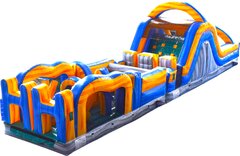
An inflatable obstacle course thrives on head-to-head runs. People cheer, they time themselves, and then they want a rematch. Mirror that energy with a bank of two-player or three-player games. Balloon pop races, strike-a-light boards, or down-the-clown frames make sense. If your inflatable obstacle course is 40 feet or longer, you will see 70 to 120 racers per hour if you run two lanes. Add a stopwatch and a dry-erase leaderboard near the finish, and pair it with a long-range beanbag or ring station so friends can play while waiting for their competitor’s turn.
For school field days, we often place obstacle course rentals in the center with carnival game clusters at each corner. Teachers move classes around like stations. The games benefit from well-defined boundaries and visible prize bins, and the obstacle course remains a centerpiece with predictable lines.
Toddler-friendly moonwalk rentals and gentle, tactile games
For ages 2 to 5, quiet wins. Soft-tip archery is still too intense for many littles. Favor rolling ball mazes, duck ponds, rubber fish-and-rod games, and colorful plinko with oversized pucks. Keep the bounce house rotation at 90 seconds, and position the games a few steps away so little feet do not wander far. A combo bounce house is usually too much for this age unless it is a low-profile toddler combo with netted visuals and a short climb.
Layouts that reduce chaos and save volunteers
Space dictates flow. In a 30 by 50 foot backyard, I like to pin the bounce house against the far back corner, place carnival games on the long side within sightline, and reserve the near corner for concession machine rentals. Lines run along the fence line instead of across the turf, and you avoid a tangle in the middle. In a parking lot, chalk lanes help. Two lanes into the bounce house with a volunteer at the gate sets tone and safety from the jump.
For church event inflatables and fundraisers, cluster games into a U shape with one prize redemption table in the middle. Guests can see options at a glance, and you use fewer volunteers. For corporate event rentals where adults mingle and kids roam, push games closer to the food and conversation areas. Adults will drift over, try the free-throw challenge, and engage longer than they would at a standalone kids zone.
Lighting deserves a mention. If the event runs past dusk, clip-on LED lights for game fronts and a light for the bounce house entry add both safety and charm. A single 15 amp circuit powers many compact game lights and a small sound system. Keep your blower power on a separate circuit per blower, especially with larger inflatable party rentals.
Prize strategies that do not break the bank
Prizes are optional. The experience is the draw. That said, a small prize table turns short games into mini-missions. Keep it simple. Offer a ticket or bead bracelet for each game win, then let kids swap 3 tickets for a small prize like stickers or finger rockets. The economy works because the fastest games generate the most tickets, but the most coveted prizes require a few wins. Even at 50 to 100 guests, a $60 to $120 prize budget can cover the visible bins for a two to three hour event.
Some hosts prefer prize-less play for backyard party rentals to avoid keeping score between siblings. In that case, turn games into challenges with photo moments. For example, set a chalk sign by the ring toss: Land 2 rings, snap a pic with the champion hat. The keepsake becomes the reward.
Safety and staffing, the quiet backbone
Inflatables run safely with clear rules and a steady adult at the entrance. Carnival games reduce risk if they do not lure kids into the bounce zone without checking in. Anchor your line starts with cones and signs. Keep blower cords taped or ramped. If wind gusts hit 20 to 25 mph sustained, plan to pause tall units like slides.
One trained attendant can manage a standard bounce house, but your ratios change with water slides or long obstacle courses. For water slides above 15 feet, use two attendants - one at the ladder and one at the splash pool. For obstacle courses, one at the start and one at the exit maintain flow and fairness. Volunteers rotate better if you provide a quick brief: rotation times, max capacity, what counts as a fair win on skill games, and when to call for a reset.
Weather pivots that keep the fun going
Light rain is less of a problem for carnival game rentals than for inflatables. Vinyl gets slick, and blowers should not sit in puddles. Build a pivot. If drizzle threatens, shift the most portable games under a canopy and keep a single dry inflatable like a standard bounce house open. If heat beats down, swap the hardest toss games for shaded stations and pull out a water-mister arch near the slide.
For wind, low-profile units like classic bounce houses and toddler playlands fare better than tall slides. Games on weighted tables stay usable. Sandbag your game legs, and carry a handful of spring clamps to keep tablecloths from sailing away.
Power and spacing, measured in real numbers
Most bounce house rentals run a single 1 to 1.5 horsepower blower, drawing 7 to 12 amps. Large slides use two blowers, which should be on separate circuits. Carnival game rentals are usually power-light unless you add a lighted backdrop or a sound element, often drawing under 2 amps per string. Keep 6 feet clear around the bounce house, more on the entry side. Place games at least 8 to 10 feet from the inflatable so children queuing for a game do not back into the safety perimeter.
On turf, lay down two 4 by 6 foot mats at the bounce entry to cut grass transfer. For water slides, use a 10 by 10 mat or a roll of turf underlayment at the exit to reduce mud. On asphalt, rubber tiles keep knees and beanbags happier.
Pairings that consistently deliver
Some combinations work nearly everywhere because they align energy, footprint, and age appeal. Use these as starting points, then adjust for theme and budget.
- Standard bounce house beside ring toss and plinko, with a small prize table. Works for 3 to 10 year olds, needs roughly 20 by 30 feet. Combo bounce house with basketball toss and milk bottle knockdown. Good for mixed ages 4 to 12, covers 30 by 40 feet including lines. 18 to 20 foot water slide with duck pond, bubble station, and shaded seating. Thrives in warm weather, plan 30 by 60 feet and hose access. 40 to 70 foot inflatable obstacle course with two head-to-head carnival games and a visible timer board. Designed for school or corporate picnics with older kids and adults, likes 20 by 80 feet clear. Toddler moonwalk with rolling ball maze and magnet fishing. Perfect for preschool fairs, best near a quiet seating pod.
Budgeting without creating a bare-bones feel
The phrase party equipment rentals covers a lot: inflatables, games, concessions, seating, generators, even themed decor. The temptation is to go wide and thin. Instead, go for one marquee inflatable and a compact trio of games, then add two comfort items that multiply value.
For a 40 guest backyard party, a practical mix might be a combo bounce house, two compact games, and table and chair rentals for 20. If budget allows, add a cotton candy or popcorn machine from concession machine rentals. The aroma acts like a second marquee attraction. Generally, a solid neighborhood setup lands in the $400 to $900 range depending on region, duration, and day of week. Larger school or corporate event rentals with obstacle courses and multiple games can range much higher, especially with staffing included.
If you are browsing inflatable rentals near me and see bundle discounts, check whether those packages include delivery window flexibility and setup help. An extra 30 minutes of setup time often matters more than a small discount, especially on tight lots or shared fields.
Themes that tie everything together
Themes do not need full fabric backdrops or custom graphics. Simple color choices and one or two on-brand games do plenty. For a sports day, mix a sports combo bounce house with football toss and free-throw shots, then use pennant bunting on the prize table. For a carnival day at a church festival, a striped classic bounce house plus ring toss, down-the-clown, and popcorn creates the right cue. Corporate summer picnics often do best with a neutral obstacle course and all-ages games like giant Jenga and cornhole mixed with a classic toss frame. Consistency in color and sign style makes everything feel elevated.
Throughput planning for real crowds
Line management is not glamorous, but it is where satisfaction lives. If you expect 150 kids at a school event, two inflatables make sense - for example, a combo and an inflatable obstacle course - plus four to six carnival games. You will see lines naturally self-balance as kids break off to compete or rest. A single bounce house plus two games will struggle at that scale. For 50 or fewer guests, one inflatable with two games is usually plenty.
Rotation timing rules help. A kitchen timer at the bounce house, set for two or three minutes, ends debates. For obstacle courses, races decide turnover cleanly. Post a polite sign with rules that adults can point to. Make it short and friendly: socks on, no flips, wait for the whistle.
Maintenance and presentation, the overlooked differentiators
Clean vinyl and crisp game faces make everything feel safer and more professional. Ask your provider about cleaning and sanitizing routines, especially if moonwalk rentals will be used by toddlers. Vinyl should feel clean and dry, not tacky. Beanbags should not smell musty. If you run your own inventory, air out soft goods between events and keep a small repair kit for loose game decals and chipped bottle paint.
Presentation also covers sound. A small Bluetooth speaker with upbeat but not blaring music sets tempo. Keep volume halfway so attendants can be heard. For church courtyards and office campuses, check local sound policies to avoid last-minute cutoffs.
Insurance, permits, and ground rules
Legitimate event rentals outfits carry liability insurance and can provide a certificate on request. If staking is required in a public park, many municipalities ask for a permit and a call to mark utilities. Water slides require a nearby hose bib, and some parks restrict them to protect turf. Community centers and school districts often demand additional insured language. Build at least two weeks of lead time for paperwork.
A quick word on terrain. On slopes, keep entries and games on the higher side so kids do not roll or slide unsafely. On gravel, always lay protective flooring. On artificial turf, confirm whether water is allowed before booking water slide rentals.
A note on concessions and dwell time
Food changes how long people stay. Popcorn or cotton candy from concession machine rentals keeps families on site an extra 30 to 45 minutes in my experience. Place concessions between inflatables and games so guests naturally loop past both zones. If heat is a factor, shave ice eclipses everything. Plan for a waste station and a hand-cleaning spot. Sticky fingers and beanbags do not mix.
When to scale up to a second inflatable
If your headcount crosses 80 kids, or your event spans more than three hours, consider adding a second inflatable rather than doubling your games. Two inflatables divide the crowd more effectively and reduce weariness for attendants. Games then serve as the glue that keeps the loop engaging. A favorite tactic is to match a high-intensity unit, like a slide or obstacle course, with a classic bounce to offer a true high and low option.
Common pitfalls and how to dodge them
New hosts sometimes line up every attraction in a row. It looks neat, but lines cross and younger kids wander. Break visual sightlines a little so queues form naturally. Another mistake is putting the prize table too close to the inflatables. It creates bottlenecks and temptation for tiny hands. Keep it near the games cluster instead.
Watch for too many similar games. Three toss games side by side feel redundant. Mix throw, roll, aim, and chance. Finally, do not bury your seating. Parents who can sit within sight of both inflatables and games stay longer and monitor better.
A simple planning checklist that covers the bases
- Headcount by age group, with a realistic peak time window. Space map with measured footprints for each inflatable and game cluster. Power plan by circuit, with separate lines for blowers and lights. Staffing schedule with 30 to 60 minute volunteer rotations and quick training notes. Weather pivot, including canopy locations and backup game placements.
Real-world scenarios and what worked
For a spring elementary carnival, we anchored a 65 foot inflatable obstacle course in the center, flanked it with football toss and a three-hoop free-throw frame, and placed a classic bounce house plus ring toss at one corner. Two concession machines - popcorn and cotton candy - sat near the entrance to capture arrivals. Six volunteers ran the whole thing with clear lanes and a two-minute race rule. Peak crowd hit 180 kids over two hours, and wait times stayed under eight minutes at the obstacle course.
A church picnic on a shaded lawn opted for a 15 by 15 moonwalk and four compact games with a small prize table. The organizer wanted a slower pace and space for conversation. We tucked the games under trees, used muted signage, and skipped megaphones. Families lingered, toddlers toddled, and the event felt neighborly.
At a corporate summer outing, we paired a 20 foot water slide with a toddler bounce and three games. Adults kept sliding long after the kids discovered the duck pond and bubbles. Photo ops were everywhere. The company posted a highlight reel the next day, which did more for morale than any stage program would have.
The bottom line
Bounce house rentals create energy. Carnival game rentals add the reset, the refresh, and the inclusive fun that keeps guests cycling and lines friendly. When you combine them with smart layout, clear staffing, a light prize strategy, and small comforts like shade and seating, you get an event that moves smoothly and feels generous.
Whether you are planning backyard party rentals for a birthday, school event rentals for a field day, church event inflatables for a festival, or corporate event rentals for a family picnic, choose one anchor inflatable, two to four complementary games, and the right support pieces from party entertainment rentals. Ask questions, map your space, and lean into variety. The right pairings do not just fill a yard. They shape the day.